
Upper Back Stretch for Truck Drivers: Relieve Shoulder Blade and Neck Pain in the Driver’s Seat
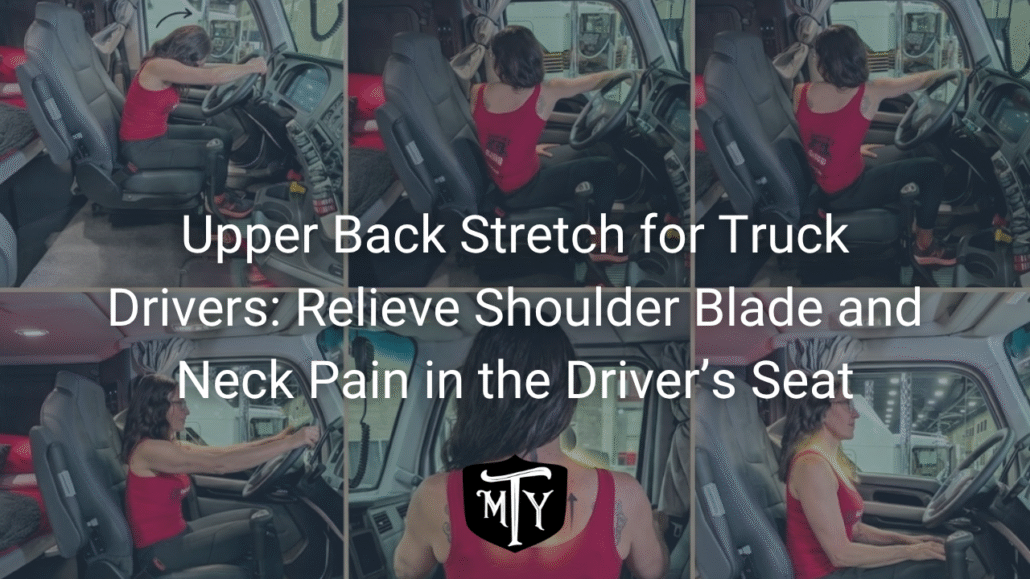
Upper Back Stretch for Truck Drivers: Relieve Shoulder Blade and Neck Pain in the Driver’s Seat
By Hope Zvara, Mother Trucker Yoga
If you drive for a living, you know that upper back tension is real.
That ache between your shoulder blades.
That burning feeling across the upper back.
That tightness that creeps into your neck.
That discomfort that gets worse after hours behind the wheel, especially if you drive manual or spend a lot of time shifting, reaching, gripping, or bracing through the shoulders.
That pain is not random.
Your body is responding to the position you spend hours in every single day.
At Mother Trucker Yoga, I always remind drivers that your body adapts to what you do most. If you sit rounded forward, grip the wheel, tense the shoulders, and rarely move your spine, your body starts to believe that is your new normal.
But it does not have to stay that way.
This simple upper back stretch for truck drivers can be done right from the driver’s seat when you are parked, and it can help relieve shoulder blade pain, upper back tightness, and even neck tension caused by long hours of driving.
Why Truck Drivers Get Upper Back and Shoulder Blade Pain
Driving puts your body in a very specific position.
Your arms are forward.
Your shoulders are slightly rounded.
Your head may drift forward.
Your upper back often rounds toward the seat.
Your chest tightens.
Your shoulder blades spread apart and stop moving well.
Over time, this can create discomfort in the muscles between the shoulder blades and along the neck.
The Cleveland Clinic notes that posture, ergonomics, and staying active all play a role in preventing upper back pain. They also explain that the back muscles help control posture, movement, and even breathing. You can read more here:
For drivers, this matters because you are not just sitting. You are sitting under tension. You are watching traffic, managing mirrors, holding the wheel, shifting, reacting, and staying alert for hours at a time.
That combination can create a lot of upper body strain.
Why Manual Driving Can Make It Worse
If you drive manual, your upper back and shoulders may work even harder.
Repeated shifting, reaching, pulling, and stabilizing can create extra tension through the shoulder blade area. Even if the movement seems small, repetition adds up.
And if your posture is already rounded or your seat position is not supporting you well, your upper back muscles are forced to work from a disadvantaged position.
That is when you start feeling:
Pain between the shoulder blades
Tightness at the base of the neck
Burning across the upper back
Stiffness when turning your head
Pain that gets worse as the day goes on
A sense that you need to “crack” or stretch your upper back constantly
This is your body asking for movement.
Proper Sitting Posture Matters
Before we get into the stretch, let’s talk posture.
Good posture in the driver’s seat is not about sitting perfectly stiff. It is about giving your spine support and allowing your muscles to work properly.
Try this quick posture check:
Sit tall on your sitting bones.
Keep your pelvis level instead of tucked under.
Let your shoulders relax down away from your ears.
Keep your head stacked over your ribs instead of jutting forward.
Adjust the seat so you are not reaching too far for the wheel.
Avoid leaning into one hip for long periods.
Cleveland Clinic shares that improving posture and training the shoulder blades can help reduce strain and improve alignment:
The better your posture, the less your upper back has to fight all day.
But posture alone is not enough.
You still need to move.
Why Stretching Regularly Throughout the Day Matters
One stretch once in a while can feel good.
But frequent movement is what creates change.
When you stretch regularly throughout the day, you help:
Improve circulation
Reduce stiffness
Release muscle tension
Restore shoulder blade movement
Improve spinal mobility
Reduce neck and upper back strain
Interrupt the effects of long-term sitting
Think of stretching like maintenance.
You would not wait until your truck breaks down to check on it. So do not wait until your body is screaming before you move it.
This upper back stretch for truck drivers is designed to be quick, practical, and easy to do when parked.
Muscles This Stretch Targets
This stretch focuses on the upper back and shoulder blade area.
You may feel it through:
Rhomboids
These muscles sit between your shoulder blades and help pull the shoulder blades together. Healthline explains that the rhomboids help stabilize the shoulders and support posture:
Trapezius muscles
The traps run from your neck across your shoulders and upper back. Cleveland Clinic notes that trapezius irritation can contribute to upper back pain, neck pain, headaches, muscle spasms, and pain between the shoulder blades:
Rear shoulder muscles
These help control shoulder movement and posture.
Thoracic spine muscles
These muscles support rotation and extension through your upper back.
When these muscles are tight, weak, or overworked, your neck often jumps in to help. That is one reason shoulder blade pain and neck pain often show up together.
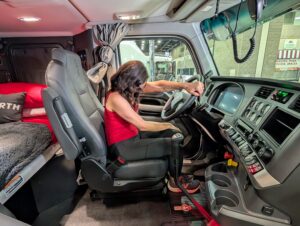
Upper Back Stretch for Truck Drivers in the Driver’s Seat
Important reminder: This stretch is only to be done when the truck is parked.
Step 1: Sit Tall and Rotate
Sit tall in your driver’s seat.
Rotate your torso toward the driver’s side window.
Try to turn from your ribs and upper back, not just your neck.
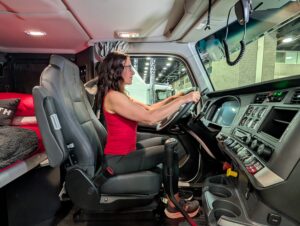
Step 2: Grab the Grab Bar
Reach your right arm across and grab the grab bar.
If the grab bar is not available, you can hold the door, side of the steering wheel, or another stable point.
Keep your grip firm but not tense.
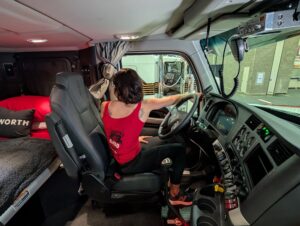
Step 3: Exhale and Round the Upper Back
Take a breath in.
As you exhale, round your upper back and gently lean back into the shoulder blade of the reaching arm.
You are not yanking or forcing.
You are creating space between the shoulder blade and spine.
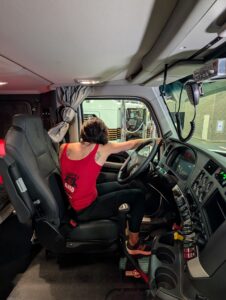
Step 4: Drop Your Head and Breathe
Let your head drop gently.
Breathe into the upper back.
You may feel the stretch between the shoulder blades, across the back of the shoulder, or into the neck.
Keep the jaw relaxed.
Photo Placeholder: Step 4 Image Here
Step 5: Move Around to Find the Stretch
This is where I want you to listen to your body.
Slightly shift your angle.
Round a little more.
Rotate a little less.
Lean back slightly.
Drop your chin.
Breathe deeper.
Find the spot that gives you that “there it is” feeling.
Photo Placeholder: Step 5 Image Here
Step 6: Hold for 30 to 60 Seconds
Once you find the stretch, hold it for 30 to 60 seconds.
Do not hold your breath.
Let each exhale help soften the tension.
Photo Placeholder: Step 6 Image Here
Step 7: Repeat on the Opposite Side
To stretch the opposite side, you have a few options.
You can use the steering wheel.
You can hold your outer hip.
You can slide over to the passenger seat and repeat the same setup on that side.
Choose the version that feels safest and most effective for your body.
Watch the Video
Benefits of This Upper Back Stretch for Truck Drivers
This stretch is simple, but powerful.
It can help:
Release tension between the shoulder blades
Reduce neck tightness
Improve upper back mobility
Decrease stiffness from driving
Support better posture
Improve breathing space through the ribs
Relieve stress held in the upper body
Help drivers feel more comfortable after long hours behind the wheel
Healthline shares a similar concept with rhomboid stretching, recommending reaching forward and holding to create a stretch between the shoulder blades:
Medical News Today also explains that stretching the rhomboids may help relieve tightness between the shoulder blades:
How Often Should Drivers Do This Stretch?
If you are driving long hours, try this stretch:
Before starting your day
At fuel stops
When parked during a break
After a long shift
Before bed in the sleeper
A good goal is 2 to 4 times per day, especially if you already deal with shoulder blade or neck pain.
You do not need to do it forever.
You just need to do it consistently.
When to Be Careful
This stretch should feel like a deep release, not sharp pain.
Stop if you feel:
Sharp pain
Numbness
Tingling down the arm
Dizziness
Pain that worsens as you hold the stretch
If symptoms continue or get worse, check with a medical professional.
Mother Trucker Yoga Reminder
At Mother Trucker Yoga, we are not here to give drivers complicated routines that do not fit real life.
We are here to help you move better in the life you are already living.
That means driver’s seat stretches.
Truck step workouts.
Sleeper mobility.
Breathing techniques.
Simple tools that work on the road.
Because every movement matters.
Every movement counts.
And sometimes one small stretch done regularly can be the thing that changes your entire day.
Final Thought
Your upper back pain is not something you have to just live with because you drive for a living.
Your body is asking for movement.
Give it a few minutes.
Give it attention.
Give it consistency.
This one upper back stretch for truck drivers can help you release shoulder blade tension, reduce neck pain, and feel better behind the wheel.
You do not need perfect conditions.
You just need to start while parked, breathe, and let your body remember how good it is supposed to feel.



Leave a Reply
Want to join the discussion?Feel free to contribute!